










WHAT DOES IT MEAN TO KNOW ONE’S LANGUAGE?
🗓️ 16 October 2026, 11:45 AM 📍 Faculty of Humanities and Social Sciences (FFZG): Room D-5 🔓 Open for all Join us for a thought-provoking talk about the nature of our…
A joint programme of
Can I apply?
Who can enrol, what to submit, and how applications are assessed.
How to applyWhat would I study?
Over forty mandatory and elective courses across six modules, taught at FFZG and FER.
Browse coursesWhat do students make?
What our students build and research, and how you can get involved.
See projects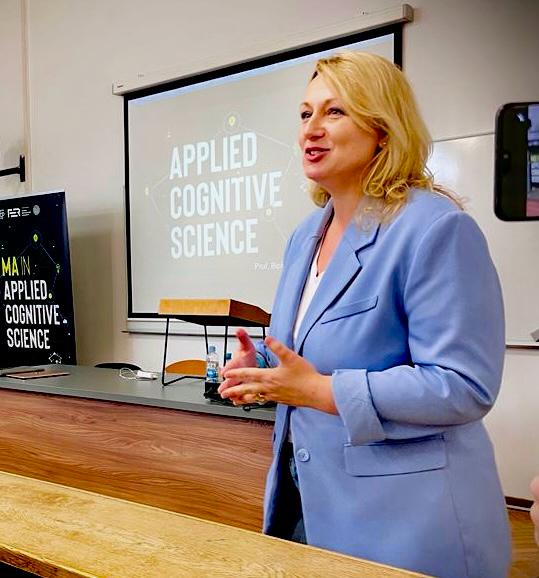
Our cognitive scientists innovate where humans intersect science, technology, and markets.
Our graduates learn to create interdisciplinary collaboration, technological development and innovation, leading to excellence and sustainable growth in both science and industry.
What the Center holds itself to, in teaching and in research.
🗓️ 16 October 2026, 11:45 AM 📍 Faculty of Humanities and Social Sciences (FFZG): Room D-5 🔓 Open for all Join us for a thought-provoking talk about the nature of our…
Our alumni, students and guests gathered to celebrate the promotion of the Program’s first generation. For some it was the culmination of an academic life; for others a…
The teaching timetable for the winter semester of 2026/2027 is now on the site, for the first and third semester. Every session carries its hours, its room and the…
Rebecca Milosavljević on cognitive biases in large language models — where they come from, and what can be done to reduce them. Candidate: Rebecca Milosavljević Title…
Two master's theses on self-voice perception: Ana Ivanišević on depersonalization and inner speech, and Jelena Paulić on proneness to hallucination — both asking what it…
Four master's theses to be defended probe human cognition across its interfaces with other people, artificial intelligence, everyday reasoning tools, and the body itself…
Cognitive science happens where minds, machines and disciplines meet.
If your work belongs in that conversation, we would like to hear from you.